Selling a home yourself is challenging anywhere. Selling one in a coastal market adds another layer entirely.
In Southeastern Coastal North Carolina, buyers aren’t simply comparing bedrooms, bathrooms and square footage. They may be comparing neighborhoods, proximity to the water, flood considerations, outdoor living spaces, boating access, community amenities and very different versions of what “coastal living” means.
Some buyers already live here. Others are relocating from hundreds of miles away and may know the area primarily through what they see online.
That makes marketing especially important.
For a coastal FSBO seller, your job isn’t simply to put your house on the market. You need to help prospective buyers understand where it is, what makes it different and what kind of lifestyle comes with it.
And that requires more than good intentions and a smartphone.
It requires a marketing strategy.
Coastal Buyers Aren’t Necessarily Local Buyers
One of the biggest differences between selling a home in a coastal destination market and selling in many other places is the potential geographic reach of your buyer pool.
A prospective buyer may currently live in Raleigh, Charlotte, Northern Virginia, New Jersey, Ohio or somewhere else entirely.
They may be planning a retirement move.
They may be relocating for work.
They may want to live closer to family.
They may have vacationed along the North Carolina coast for years and finally decided to make it home.
Whatever brings them here, there’s a good chance they’ll encounter your property online long before they ever see it in person.
That changes the job your marketing needs to do.
You’re not simply trying to persuade someone to schedule a showing. You’re helping someone sitting hundreds of miles away decide whether your home — and your particular corner of the Cape Fear region — deserves a place on their shortlist.
You’re Selling More Than a House
Every home has a location.
Coastal homes have a context.
A buyer may want to understand how your property relates to beaches, waterways, marinas, shopping, restaurants, parks, golf, medical facilities, airports and other destinations important to everyday life.
But lifestyle goes deeper than a map.
Maybe your home has a screened porch that becomes an extra living room for much of the year.
Perhaps there’s room in the garage for paddleboards and fishing gear.
Maybe the neighborhood has sidewalks perfect for an evening dog walk.
Perhaps there’s a public boat ramp nearby.
Maybe the backyard has mature live oaks, established landscaping or the kind of privacy that’s increasingly difficult to find.
These details help tell the story of a property.
Experienced real estate marketing looks beyond the standard property specifications and asks:
Why would someone want to live here?
That’s the story your marketing needs to tell.
“Coastal” Isn’t One Thing
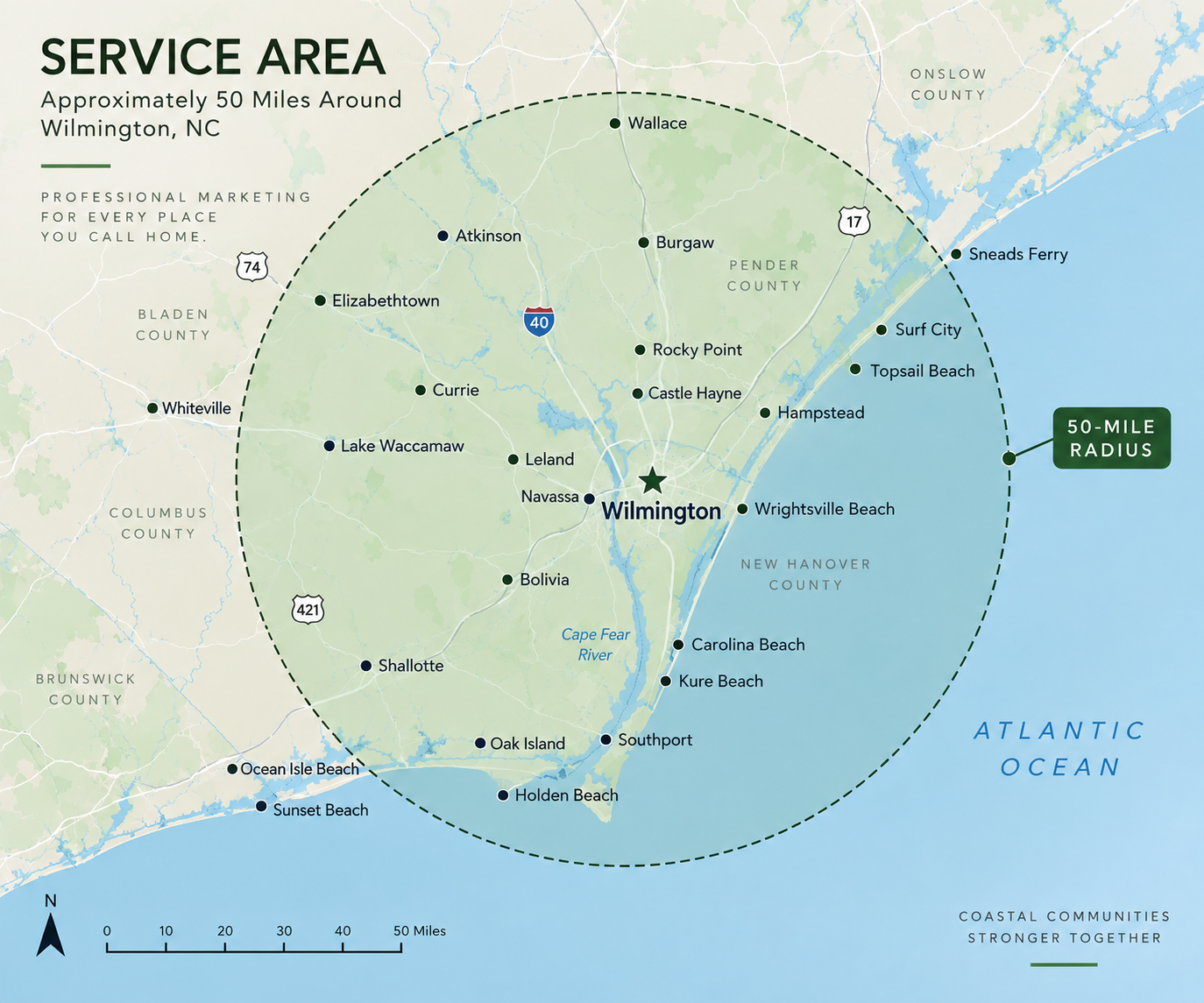
This is particularly important in the greater Wilmington market.
Living in Wilmington isn’t the same experience as living in Wrightsville Beach. Carolina Beach isn’t Kure Beach. Hampstead isn’t Leland. Southport isn’t Oak Island.
Even within individual communities, neighborhoods can have distinctly different personalities.
One property may appeal to buyers looking for an active coastal lifestyle. Another may attract someone looking for privacy and quiet. One buyer may prioritize boating access while another cares far more about restaurants, shopping or a short drive to the beach.
Effective marketing identifies the lifestyle associated with your particular property rather than relying on generic coastal language.
Palm trees, seashell graphics and the word “paradise” aren’t a marketing strategy.
Specificity is.
Your Photography Has to Do More Work
When buyers are shopping remotely, photography becomes enormously important.
Your photos aren’t simply documenting the house.
They’re giving buyers their first tour.
A prospective buyer should be able to move through the images and begin to understand the property: how rooms connect, where the natural light comes from, what the outdoor spaces look like and which features deserve special attention.
That requires more than taking wide shots of every room.
Good property photography tells a visual story.
It captures the obvious features — kitchen, living areas, bedrooms and baths — but also the details that help distinguish the home.
Maybe it’s a beautifully renovated shower.
A fireplace.
Built-in shelving.
A screened porch.
An outdoor shower.
A workshop.
A view from the breakfast table.
A large pantry.
A fenced yard.
An unusually beautiful live oak.
The goal is not simply to prove that these features exist. It’s to help buyers imagine how they might experience them.
Drone Photography Can Provide Context a Ground-Level Photo Can’t
In coastal markets, location and surroundings can be a significant part of a property’s appeal.
That’s where drone photography can be particularly effective.
Aerial imagery can help buyers understand how a home sits within its neighborhood and how the neighborhood relates to surrounding features.
Depending on the property, that might include nearby waterways, community amenities, green space, marinas or other geographic features.
Drone photography shouldn’t be used simply because it looks impressive.
It should answer a question.
Where is this property, and what surrounds it?
For an out-of-area buyer, that perspective can be extremely valuable.
Video Helps Remote Buyers Experience the Property
Still photography captures individual spaces beautifully.
Video does something different.
It communicates movement and flow.
A well-produced property video can help buyers understand how the kitchen connects to the living room, how the indoor space transitions to the porch or backyard, and how the home’s most appealing features relate to one another.
Short-form video can also be valuable for social media, where you’re trying to earn attention before asking someone to click through for more information.
The key is knowing what each format is supposed to accomplish.
Photography, video, drone imagery and social content shouldn’t be disconnected pieces.
They should work together.
Your Listing Copy Needs to Speak to Coastal Buyers
This is another place where FSBO sellers often struggle.
It’s difficult to write objectively about your own home.
You know too much about it.
You may focus on the improvements that cost you the most money rather than the features buyers find most compelling. Or you may overlook something valuable simply because you’ve lived with it for years.
Good listing copy translates property features into buyer benefits.
Instead of simply saying:
“Large screened porch.”
Consider what that feature actually means:
A spacious screened porch extends the living area outdoors and creates a comfortable spot for morning coffee, evening meals or entertaining friends.
Instead of:
“Fenced backyard.”
Think about the potential buyer:
The fully fenced backyard provides private outdoor space for pets, gardening and entertaining.
Good copy isn’t about piling on adjectives.
It’s about helping buyers understand why a feature matters.
Coastal Marketing Needs to Be Accurate, Too
There is another reason coastal sellers benefit from experienced marketing guidance: certain claims need to be handled carefully.
Water views, water access, flood zones, beach access, community amenities, rental potential and similar subjects can materially affect how buyers perceive a property.
Marketing language shouldn’t turn assumptions into facts.
For example, there’s an important difference between a property having nearby water access and having deeded water access. There’s a difference between being near a beach access and having private access. And statements about rental possibilities or property uses shouldn’t be made casually without understanding applicable rules and restrictions.
Good marketing isn’t about exaggerating the property.
It’s about presenting its genuine advantages clearly and accurately.
Credibility matters.
Social Media Requires More Than Posting a Listing Link
A common FSBO strategy looks something like this:
Put the property online.
Copy the link.
Post it on Facebook.
Wait.
That’s distribution, but it isn’t much of a marketing campaign.
Social media works differently.
People aren’t usually scrolling Facebook or Instagram hoping to read a property listing. You have to give them a reason to stop.
That might be a dramatic exterior image.
A beautiful kitchen.
A quick video tour.
An aerial view.
A surprising feature.
A “five things you’ll love about this home” post.
A neighborhood highlight.
An open-house announcement.
Different pieces of content can introduce the property from different angles while leading interested buyers back to one central source for complete information.
That’s marketing.
Your Property Needs a Digital Home Base
A dedicated property landing page can be especially valuable for an independent seller.
Instead of scattering information across social posts, online listings and messages, you can direct prospective buyers to one place containing the property’s photography, video, description, key features and other information you choose to provide.
A dedicated page also gives you something useful to connect to social posts, emails, online promotion and QR codes on signs and printed materials.
The idea is simple:
Make it easy for interested buyers to learn more.
Every unnecessary obstacle gives someone another opportunity to move on to the next property.
You Need to Market Against Professionally Presented Listings
This may be the most important point of all.
Buyers don’t browse one section of professionally represented properties and another section labeled “homes where the owner did the marketing.”
Everything competes for attention on the same screens.
Your FSBO may appear alongside properties with professional photography, drone imagery, polished listing descriptions, video tours and sophisticated digital marketing.
Buyers aren’t going to lower their expectations because you’re selling independently.
Nor should they.
If you’re asking a competitive market price for your home, your presentation should support it.
Experienced Marketing Can Also Tell You What Not to Do
Marketing advice isn’t only about adding things.
Sometimes its greatest value is knowing what to leave out.
You probably don’t need 73 nearly identical photos.
You don’t need a three-minute video of someone slowly walking through every hallway.
You don’t need every social post to say “HOUSE FOR SALE!!!”
You don’t need a paragraph of empty adjectives describing your “absolutely gorgeous, breathtaking, stunning coastal oasis.”
And you certainly don’t need to digitally manipulate a property until the marketing bears little resemblance to reality.
Good marketing is selective.
It identifies what’s strongest about the property and builds the presentation around those strengths.
Selling It Yourself Doesn’t Mean Marketing It Yourself
This is where many homeowners misunderstand the FSBO model.
They assume that choosing not to hire a traditional real estate agent means they also need to become a professional photographer, videographer, copywriter, social media marketer, graphic designer and digital strategist overnight.
They don’t.
Think about how you handle other major projects.
You can manage a home renovation yourself and still hire an electrician.
You can plan your own wedding and still hire a photographer.
You can own a business and still hire an accountant.
Selling your home can work the same way.
You remain the seller.
You decide how you want to handle inquiries, showings, negotiations and the transaction itself, bringing in appropriate legal or other professional assistance when needed.
But you can hire specialists for the parts of the process where professional expertise makes a difference.
Marketing is one of them.
That’s Especially True on the Coast
Coastal real estate has a story to tell.
Sometimes that story is about the water.
Sometimes it’s about outdoor living.
Sometimes it’s about boating, beaches or community amenities.
And sometimes the most compelling story isn’t traditionally “coastal” at all. It might be a quiet cul-de-sac, an oversized garage, a spectacular kitchen, a huge fenced backyard or a beautifully renovated home that’s fifteen minutes from everything.
The job of good marketing is to figure out what makes this particular property worth noticing.
Then communicate it clearly.
You Sell the Home. List This Helps You Market It.
At List This Consulting, we believe homeowners who choose to sell independently shouldn’t have to settle for amateur-looking marketing.
We provide professional real estate photography, video, drone imagery where appropriate, listing copywriting, social media content, property landing pages, floor plans, open-house materials and other marketing tools designed to help independent sellers present their homes professionally.
For coastal sellers, we bring another important perspective: an understanding that marketing a property here means marketing both the home and its place within the coastal lifestyle.
We look for the details.
The features.
The setting.
The amenities.
The visual moments that make someone stop scrolling.
And the story that helps a prospective buyer understand why your property deserves a closer look.
Because selling your home yourself doesn’t mean you have to figure out the marketing yourself.
Selling Your Coastal Home Yourself?
Before you put it on the market, make sure your marketing is ready to compete.
List This Consulting helps FSBO sellers professionally present and promote their properties — while keeping the sale in their hands.
Sell it yourself. Market it like a pro.